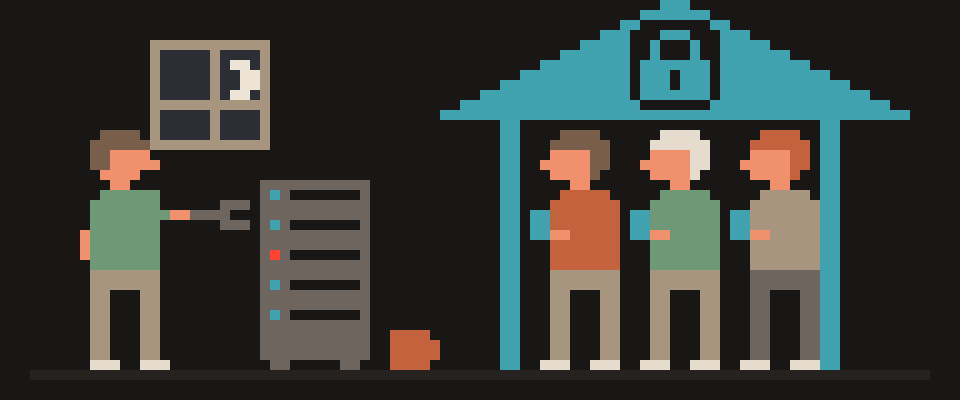
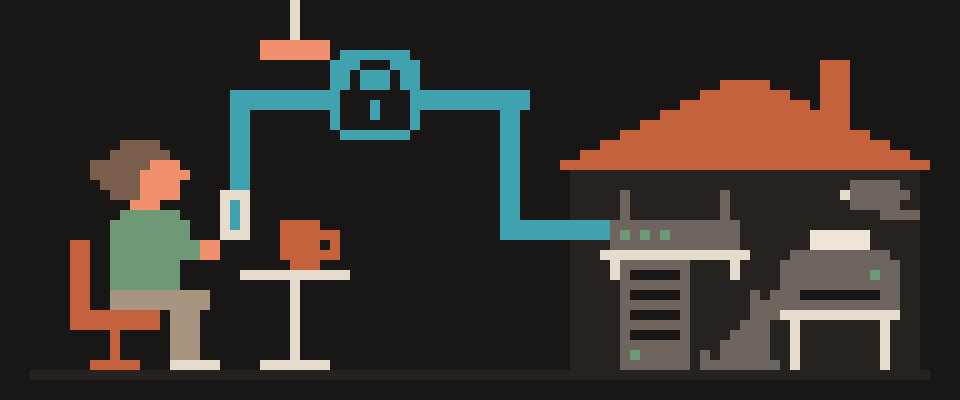
WireGuard vs Tailscale is a comparison people make as if they were rivals, and they're not: Tailscale is built on WireGuard.
WireGuard is the engine, a fast, minimal tunnel protocol that moves encrypted packets between two peers that already know each other's keys. Tailscale is the car around it: a service that hands out keys, punches through NAT so devices behind home routers can reach each other, ties every device to a login, and lets you write rules about who may reach what. Plain WireGuard is for people who want to own every bolt. Tailscale is for people who want to drive.
Below, what each layer does, where the seams are, what you give up on each side, and a straight answer for the three common situations.
                       WireGuard  Tailscale
you run it yourself    ✓          ✗
key management         manual     automatic
connects your devices  ✓          ✓
exit to the internet   ✓          extra step
free for one person    ✓          ✓
What WireGuard does
It encrypts and authenticates packets between two endpoints using one fixed set of modern cryptography, with a codebase small enough to audit end to end. You generate a key pair on each side, tell each peer the other's public key and address, and it works. What it doesn't do: distribute keys, find peers behind NAT, handle changing IP addresses of peers gracefully, manage users, or tell one device it may reach the file server but not the camera. All of that is your job, or the job of whatever you build on top. Setting it up by hand is in How to set up WireGuard, and the classic comparison with the older protocol is in WireGuard vs OpenVPN.
a protocol and a kernel module
  ├─ you distribute keys
  ├─ you pick addresses
  └─ you open the ports
nothing about it is a product
What Tailscale adds on top of WireGuard
Key exchange. A coordination server distributes public keys to every device in your network, so you never paste keys by hand. Private keys stay on the devices.
NAT traversal. Devices behind home routers and carrier NAT find each other directly using well-known hole-punching techniques, and when a direct path is impossible, traffic relays through the service's servers, still encrypted end to end.
Identity. Devices join by logging in with an identity provider account, so "who's this device" is answered by your existing login rather than by a key file.
Access rules. Policies that say which users and devices may reach which services. This is the part that turns a tunnel into a network.
Conveniences. Automatic naming of devices, a way to expose a service to the internet on purpose, and clients for every platform that stay connected across network changes.
The clients are open source; the coordination service is the company's, and there's a self-hosted alternative for people who want the whole stack in their own hands.
key exchange handled for you
devices find each other through NAT
a web console and access rules
   └─ the tunnel is still WireGuard;
      the coordination is the product
Does Tailscale see your traffic?
Tailscale doesn't see your traffic: packets go device to device on WireGuard, and the relay servers only forward already-encrypted data. What the coordination service does see is the map: which devices exist, their keys, their names, when they connect, and the rules. That's metadata about your network, and it lives with a third party. For most people that trade is fine; for some it's exactly the thing they wanted to avoid, which is why the self-hosted control server exists.
Plain WireGuard has no such third party, and also no help. Peers behind two NATs need a publicly reachable rendezvous point, which usually means a small server of your own; address changes mean editing configs; a lost phone means revoking a key by hand on every peer.
Tailscale vs WireGuard speed and battery
The data path is WireGuard in both cases, so throughput and latency are the same when a direct connection exists. Tailscale adds a little overhead when it has to relay, and its client does more background work to keep paths alive, which on phones can cost some battery. Plain WireGuard is as lean as it gets.
coordination server knows your
device list and public keys
relay used when direct fails
account is a new dependency
   └─ traffic stays end-to-end, the
      metadata does not
Is Tailscale as secure as WireGuard?
The cryptography is identical. The difference is where mistakes happen. With plain WireGuard, mistakes are yours: an exposed port, a key that never got rotated, a forgotten peer with access to everything. With Tailscale, mistakes are in policy: a rule that is too broad, a login that should have been revoked. And there's a trust question that plain WireGuard doesn't have: the coordination service. Whether WireGuard itself is secure is a separate question, answered in Is WireGuard secure.
neither hides that you use a tunnel
neither disguises itself as HTTPS
neither makes you anonymous
   └─ if that is the goal, this is
      the wrong pair to compare
Neither is a privacy VPN
Neither is a privacy VPN in the consumer sense. They connect your devices to each other or to your own server; they don't put you in a crowd behind a shared exit address in another country, and they don't hide your browsing from your ISP unless you route all traffic through one of your own machines, which then becomes your exit, with your own IP. That's a different tool for a different job; the difference is spelled out in VPN vs VPS.
reach my own machines
  └─ Tailscale
route all traffic through a server
  └─ plain WireGuard
look like ordinary HTTPS
  └─ neither: VLESS
WireGuard or Tailscale: three situations
Reaching your home network from the road. Tailscale, or its self-hosted cousin, unless you enjoy running a rendezvous server and editing configs. Plain WireGuard on the router works well if your home has a public IP; if it doesn't, the mesh approach saves the day. The home-network case in full: VPN into your home network.
A small team or a home lab with several people. Tailscale. Access rules and identity are the whole point, and rebuilding them on plain WireGuard is a project.
A single fixed tunnel between two machines you control. Plain WireGuard. Two keys, two configs, done, and nobody else in the loop.
These two solve different problems, and the right answer depends on what you're reaching.
Help me choose between plain WireGuard and
Tailscale.

What I want to reach: (my own machines / the
whole internet through a server / a work network).
How many devices: (how many).
Who else uses them: (just me / family / a team).
My comfort with servers: (I run Linux / I follow
guides / none).

Say which one fits, and what metadata the
coordination service would see in the Tailscale
case.
Do not recommend self-hosting if my answers say
I would not maintain it.
Bottom line
Same engine, different car. Plain WireGuard is a precise, minimal tool that expects you to build the rest. Tailscale packages that tool into a network with identity and rules, and charges for it in the form of a coordination service that knows your network's shape. Pick by how much you want to own, not by which is "better".
404 VPN is the third kind of thing in this space: a privacy service, not a mesh. It puts your traffic through a shared exit in another country, over VLESS in its Android and macOS apps or over a WireGuard config for Istanbul and Marseille from the dashboard, with DNS inside the tunnel and a kill switch in the Android app. Different job; it often lives on the same phone as one of the tools above. Start on the home page.